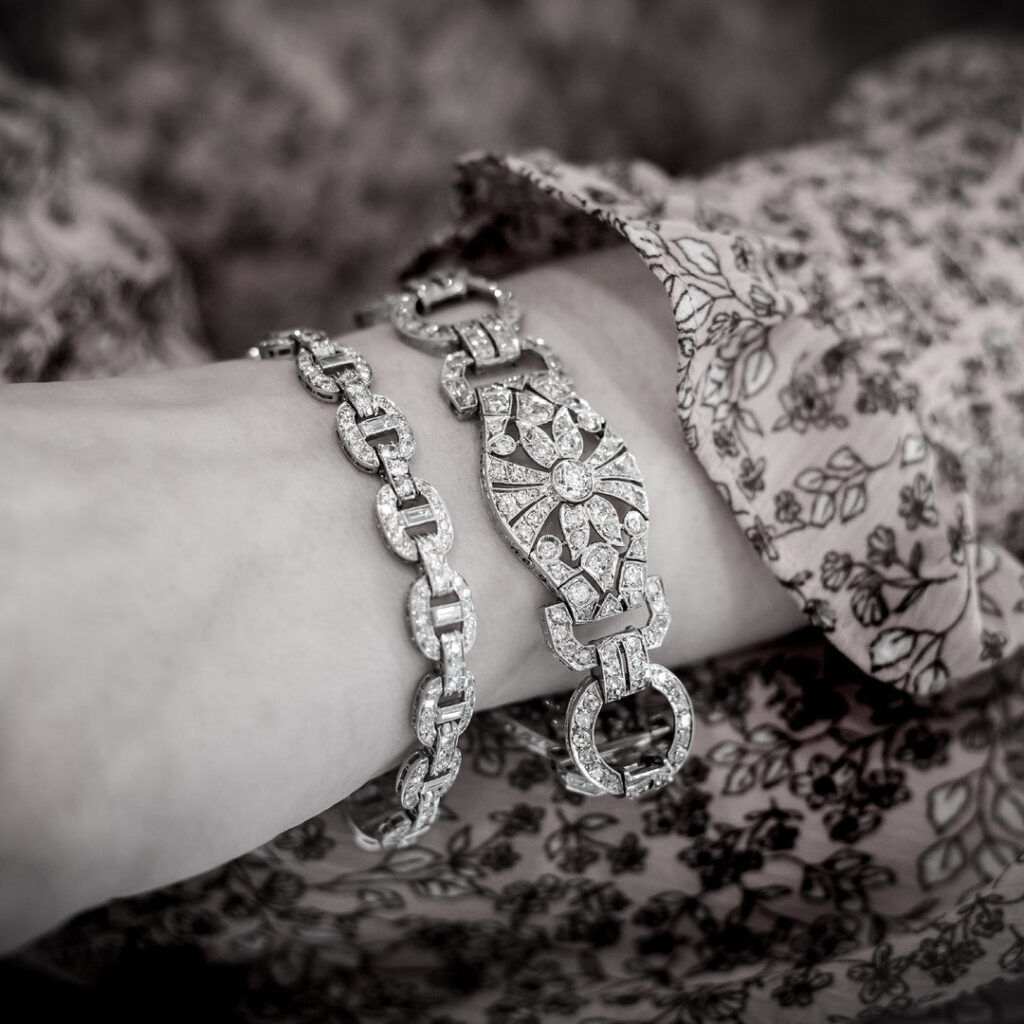
The floor of our Greensboro showroom is more than a retail space. To those of us who have spent years studying the evolution of craftsmanship, it is a living map of human ambition. Today, as I look through the Jeweler’s Loupe at a recently acquired filigree bracelet from 1925, I don’t just see a piece of jewelry. I see a silent revolution that began in Paris and found its way into the jewelry boxes of North Carolina’s textile elite. We are looking at a moment in time when the world decided to break every rule of the past.
Before the 1920s, jewelry was obsessed with nature. It was all flowing vines, soft flowers, and the romantic whimsy of the Art Nouveau movement. But the Great War changed the soul of the world. People wanted speed, power, and industrial precision. They wanted the future. That is exactly what Art Deco delivered. It replaced the curve with the line. It replaced the petal with the pyramid. When you hold a piece of authenticated Art Deco gold, you are holding the physical manifestation of the Jazz Age’s defiance.
Look at the way this specific piece is constructed. The gold isn’t just cast; it is engineered. There is a relentless commitment to symmetry that mirrors the skyscrapers rising in New York and the burgeoning industrial architecture of our own High Point furniture districts. This was a period where the jeweler became an architect on a microscopic scale. Every millgrain edge and every geometric cutout was a statement of progress. In an era where the gold price sits at $, these pieces represent a rare convergence where the intrinsic value of the metal is almost secondary to the sheer historical weight of the design.
We often talk about provenance in the vault, and Art Deco provides a paper trail unlike any other. This was the first era where jewelry was designed to be seen under the harsh, bright lights of a ballroom rather than the soft glow of a Victorian candle. The use of white gold and platinum became the standard because it provided a canvas that didn’t distract from the brilliance of the stones. It was about clarity. It was about the “Assay” of the person wearing it. It told the world that the wearer was modern, affluent, and unafraid of the coming century.
Brian often remarks that the most difficult part of our work is finding pieces that have survived the decades without losing their structural integrity. Because Deco jewelry is so intricate—often featuring “pierced” work that looks like lace made of metal—it is prone to wear. To find a pristine example here in the Triad is like finding a needle in a haystack of history. When we acquire these artifacts, we aren’t just buying gold. We are securing a legacy that survived the Great Depression and the second World War. We are protecting a sovereign wealth that has only appreciated as the craftsmanship required to create it has become a lost art.
The marketplace today is flooded with “Deco-style” reproductions, but they lack the soul of the original. They lack the specific weight of the hand-alloyed gold used by craftsmen a century ago. When you feel the heft of a genuine 1920s ring, you feel the density of a different era. You are touching a time when things were built to last forever. As we navigate an increasingly digital and ephemeral economy, there is a profound sense of security in owning something that has already proven its permanence.
The Assay
- The Metal Standard: Authentic Art Deco pieces typically utilize 14k or 18k white gold, often alloyed with nickel to achieve a “platinum look” during the transition periods of the 1920s.
- Intrinsic Value: With gold currently trading at $, the high-purity gold used in these artifacts provides a significant floor for your investment.
- Symmetry Protocol: True Art Deco is defined by strict geometric balance. If a piece is asymmetrical or features rounded, organic “whiplash” lines, it is likely Art Nouveau rather than Deco.
- The Millgrain Detail: Look for the microscopic “beading” along the edges of the metal. In authentic estate pieces, this was done by hand with a specialized wheel tool, creating a texture that modern casting cannot perfectly replicate.
- Liquidity Factor: Historical artifacts from this era remain some of the most liquid assets in the jewelry world due to their perpetual demand among collectors and investors alike.
The Discovery Link
We invite you to step into the vault and view our current collection of authenticated Art Deco treasures and rare estate acquisitions.
The Trust Link
Book a private appraisal at our Greensboro showroom to begin the process of documenting your own family legacy and identifying the true value of your historical artifacts.


