History is not merely found in textbooks; it is forged in metal and held in the palm of your hand. Most people walk the streets of Greensboro or High Point without realizing that beneath their feet lies the ghost of the first great American gold rush. Long before the 1849 cry in California, North Carolina was the beating heart of the nation’s specie production. We are standing on the ground of a forgotten empire of gold.
If you were to step back into the 1830s, the official currency of the United States was a phantom. The Philadelphia Mint was a world away, and the rugged miners of the Blue Ridge had plenty of “dust” but no way to buy a meal or a mule. Enter Christopher Bechtler. A German immigrant, a jeweler by trade, and a man who understood that value requires a physical manifestation. In 1831, he did what the Federal Government could not: he gave the South a currency they could trust.
The Bechtler Specie: A Rebel Mint in Rutherfordton
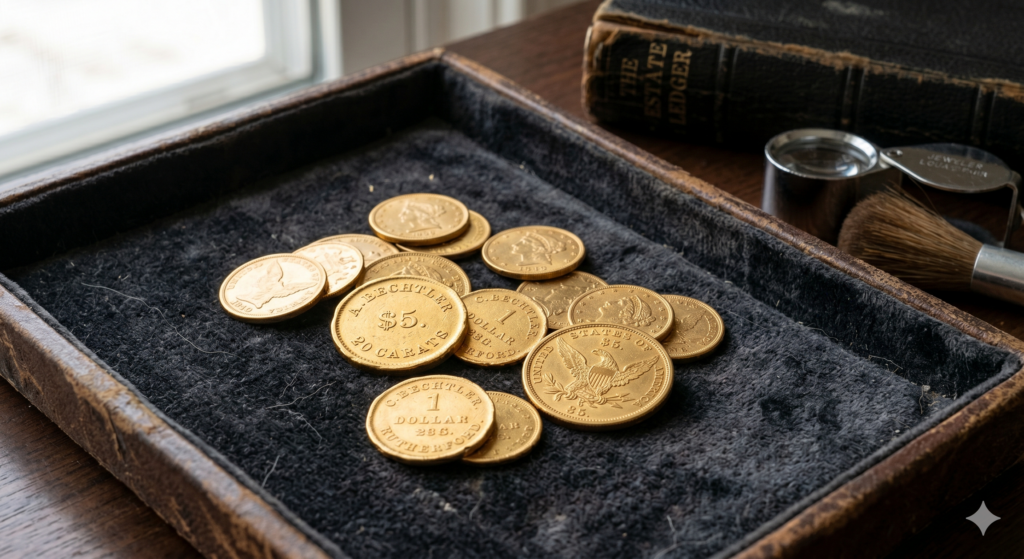
The Bechtler Gold Dollar was a revolution. It predated the United States Mint’s own gold dollar by seventeen years. This wasn’t just a convenience; it was an act of economic sovereignty. When we handle a Bechtler coin at Estate Jewelry & Loan, the air in the room changes. These are not the polished, uniform strikes of modern machinery. They are raw. They are honest.
The Bechtler family struck over $2.24 million in gold coins between 1831 and 1849. They produced denominations of $1, $2.50, and $5. What makes them breathtaking to a curator is the purity. Bechtler was so meticulous that his coins often circulated more widely than federal issues because people knew the “Carolina Gold” was exactly what it claimed to be—often 20 to 22 karats of unadulterated wealth.
Today, finding a Bechtler $5 piece with the “20 Carats” or “22 Carats” stamp is like finding a needle in a historical haystack. These artifacts can command prices ranging from $5,000 to well over $100,000 depending on the specific die variety and the preservation of the strike. They represent the ultimate acquisition for a collector who values provenance over polish.
The Charlotte Mint and the Civil War Seizure
The success of the Bechtler operation eventually forced the hand of the Federal Government. They could no longer ignore the sheer volume of gold flowing out of the North Carolina hills. In 1838, the Charlotte Mint opened its doors, striking coins with the coveted “C” mint mark.
This is where the story takes a dark, urgent turn. In 1861, at the dawn of the Civil War, the State of North Carolina seized the Charlotte Mint. The gold coins produced during this era—particularly the 1861-C Half Eagles—are the stuff of legend. They represent the final gasps of a unified currency before the chaos of the Confederacy. To hold a “C” mark gold coin is to hold a fragment of the very moment the Union fractured.
Modern Sovereignty: The Bullion Shield
While we chase the ghosts of Bechtler and the Charlotte Mint, we must not lose sight of the present. History is still being written in the price of gold and silver. In an age of digital assets that can vanish with a keystroke, physical specie remains the only true “financial lifeboat.”
At Estate Jewelry & Loan, we view every acquisition through the lens of the “Assay.” Whether it is a 19th-century gold dollar or a modern 1oz bullion coin, the intrinsic value is the floor upon which your legacy is built. As of this moment, the raw materials of history are trading at:
- Gold (1oz): $
- Silver (1oz): $
- Platinum (1oz): $
These numbers are more than just market data. They are the modern pulse of the same gold that Bechtler once hammered into shape in a small shop in Rutherfordton.
The Assay
- The Bechtler Gold Dollar: The first gold dollar ever produced in the United States (1832), predating federal issues by nearly two decades.
- Purity Standards: Bechtler coins were typically struck in 20, 21, or 22-karat gold, reflecting the raw purity of North Carolina’s “Piedmont Gold.”
- The Charlotte Mint (C-Mark): Established in 1838 exclusively to process local gold; any coin bearing the “C” mark is a high-value rarity.
- Market Liquidity: Rare NC coins possess dual value: their numismatic rarity and their high intrinsic gold content, making them premier “crisis assets.”
- Provenance: True North Carolina gold is characterized by a distinct “warm” hue, a result of the unique mineral composition of the Appalachian gold belt.


